
Discover the best diy microneedling methods! Avoid pain & risk with liquid microneedling for collagen. Get glowing skin safely.
January 30, 2026
January 30, 2026

The best DIY microneedling options people talk about today look simple from the outside.
Spicule-based serums. Dermarollers. Motorized pens.
Roll tiny needles across your face. Create microscopic wounds. Your skin responds by producing collagen and elastin. Wrinkles fade. Scars soften. Texture smooths out.
Once you look closer, the pattern shifts.
Metal needles puncturing skin thousands of times. Pinpricks of blood. Redness that hangs around for days. Infection risk from devices that never get truly sterile at home. Dull needles dragging through skin instead of piercing cleanly.
The FDA has not approved any dermarollers with needles longer than 0.3 mm for at-home use. Yet longer needles flood the market and end up in bathrooms everywhere.
And the results, when they show up, are built on one thing.
Trauma.
The needles do not improve your skin. The healing response does. The collagen synthesis. The new tissue that forms while you recover.
So the obvious question hides in plain sight.
What if you could trigger that same biological response without metal? Without blood? Without betting on your cleaning routine every time you roll a device across your face?
Nature answered that question millions of years before dermatology clinics existed.
Freshwater sponges evolved microscopic, needle-like structures called Spongilla spicules. Biology's own microneedles. No sterilization. No dulling. No cross-contamination from reused cartridges.
Just structure and function doing what they were designed to do.
We are the PureRiot Team.
We look at where skin science and human biology actually meet. We question the industry's obsession with trauma and toxic formulas that quietly erode your barrier.
We built a different path.
A 100% natural liquid microneedling serum powered by Spongilla spicules, niacinamide, hyaluronic acid, and frankincense. No synthetic preservatives. No artificial fragrance. No harsh chemicals hiding in the fine print.
This guide shows you what actually works for best DIY microneedling and why the future of collagen induction has nothing to do with metal.
For years, the promise of at-home microneedling revolved around dermarollers and pens.
Metal needles in a handle. Marketed as professional results from your bathroom.
Roll them over your skin. Create tiny punctures. Force a healing response.

The problem starts with the core assumption.
More trauma means more results.
Metal needles, even very small ones, can cause tearing and unnecessary damage when they are not used with perfect control. That level of precision is hard enough in a clinic. At home, with a roller skipping over facial curves, it is guesswork.
Then you have inconsistent depth.
At-home devices are often too aggressive in some spots and too superficial in others. Too deep and you flirt with scarring. Too shallow and you create irritation without meaningful collagen.
The FDA has openly warned about microneedling devices and their risks. Bleeding. Bruising. Redness. Infection. They have not approved dermarollers with needles longer than 0.3 mm for home use.
When you see 1.0 mm and 1.5 mm rollers online, you understand the disconnect between regulation and reality.
Hygiene is the next weak link.
A dermaroller needs actual sterilization, not just a rinse. At home, that rarely happens. Needles pick up skin cells, oil, and bacteria. Reusing them turns a treatment into an infection vector.
Sharing a dermaroller spreads that risk further. Yet it happens because the industry sold these tools as casual.
Dulling needles sit quietly in the background.
After a few uses, sharp points turn to micro-hooks. They drag and tear instead of making clean channels. That means more inflammation, more trauma, and a higher chance of lasting damage.
Meanwhile the professional side of the same system tells a similar story.
Deeper needles. Numbing cream. Blood. Downtime measured in days. Cartridges that can be reused if a clinic cuts corners, with the FDA warning about disease spread when that happens.
You are told that this is the price of results.
This old model asks you to trade pain, risk, and long-term barrier damage for short bursts of improvement that fade and demand more sessions.
It is a broken design.
What if the best DIY microneedling has nothing to do with a device in your hand?
What if the most reliable needles are already built into nature?

Freshwater sponges evolved microscopic, needle-like structures called Spongilla spicules.
Think of them as nature's microneedles.
When suspended in a serum, these mineral spicules can be massaged into your skin. They do not sit on the surface. They embed.
We are talking about millions of tiny structures entering the upper layers of your skin. Each one creating a micro-channel your body reads as a signal.
No blood. No numbing cream. No cartridges. No device to disinfect.
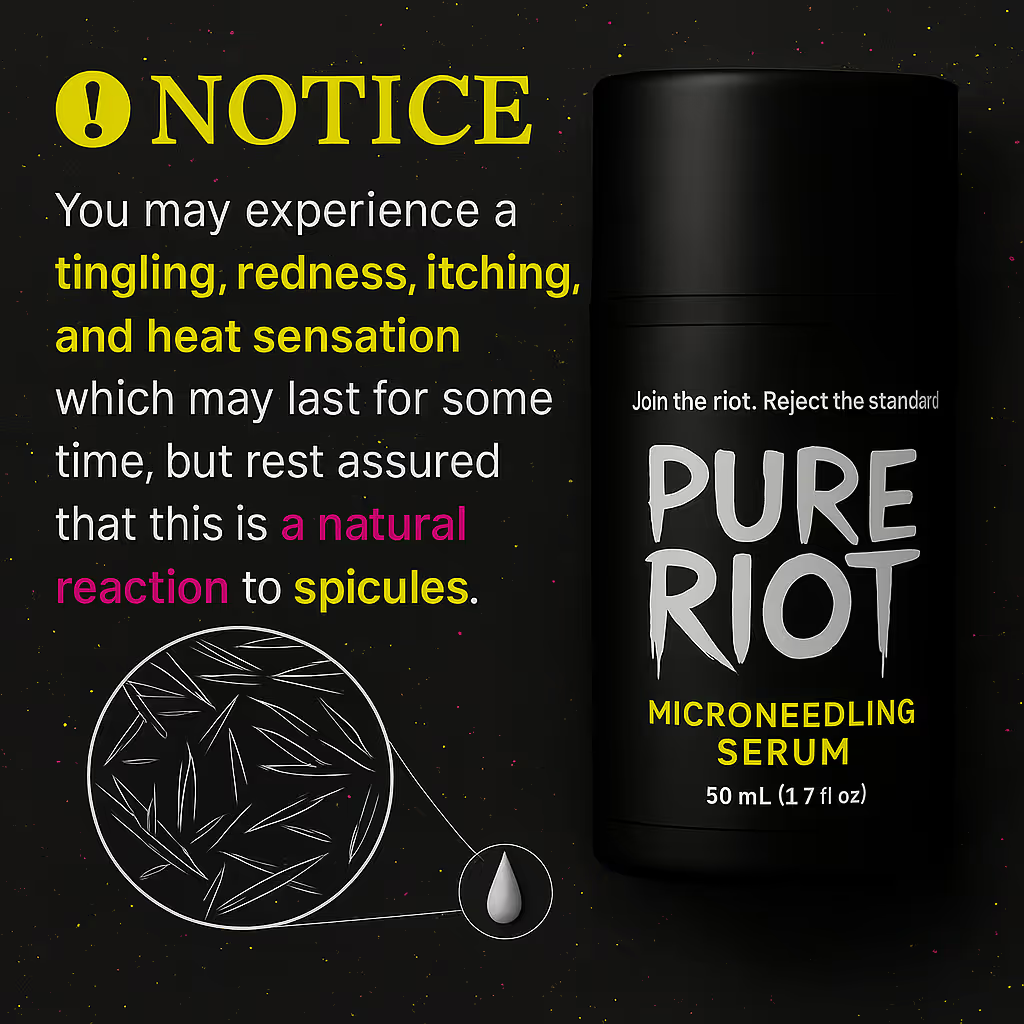
Your skin feels a gentle sting or tingle when you press on it afterward. That is not damage spiraling out of control. That is feedback.
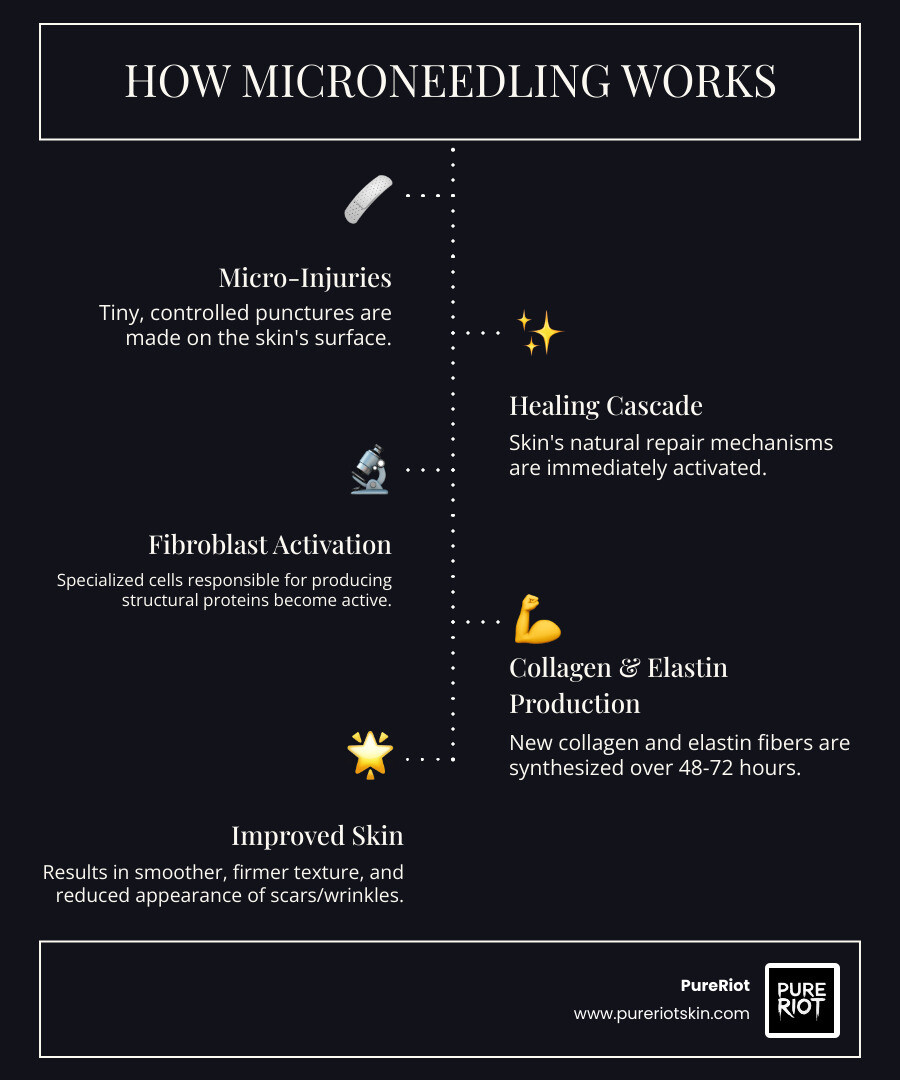
Spongilla spicules activate the same wound-healing cascade traditional microneedling chases. Fibroblasts move in. Growth factors release. New collagen and elastin begin to form.
This is neocollagenesis.
Not as a buzzword. As the difference between skin that bounces back and skin that folds and stays folded.
These micro-channels also act as doorways.
Most skincare ingredients are blocked by the stratum corneum, the outer barrier. Research shows that molecules above 500 Daltons struggle to penetrate intact skin. They sit on top, smelling nice, doing very little.
Spongilla spicules change that map.
They widen pathways and follicular openings so ingredients like niacinamide, hyaluronic acid, and plant actives can reach the cells that need them. Your routine stops being topical and starts being targeted.
The spicules stay in your skin for 48 to 72 hours.
During that time you may feel a faint prickling when you touch your face. That is millions of microscopic needles still in place, still nudging your biology to repair and rebuild.
There is no device to dull. Nothing to rust. No plastic going into a drawer and gathering bacteria.
PureRiot takes this natural microneedling system and surrounds it with a formula built on the same principles.
Spongilla spicules to create the channels.
Niacinamide to calm inflammation and support your barrier.
Hyaluronic acid to pull in water and give that new collagen a hydrated environment.
Frankincense extract to support regeneration and keep the skin's communication signals balanced.
All in a 100% natural base. No synthetic preservatives. No artificial fragrance. No hidden irritants.
You are not forcing your skin into trauma. You are giving it a clear signal and the raw materials to respond.
Choosing bio-microneedling means stepping out of the needle-and-chemical trap.
You are not trying to be your own dermatologist. You are working with your biology.
Preparation is not about stripping your face.
It is about clearing the noise so your skin can focus on one thing.
Repair.
Cleanse with a gentle, non-stripping cleanser. No harsh foaming agents. No strong actives at this step.
You are about to create pathways into your skin. What sits on the surface will have an easier route in.
That is why you skip retinoids, strong acids, benzoyl peroxide, and aggressive exfoliants for at least three days before you use a spicule serum.
Keep your skin calm.
Avoid heavy sun exposure and waxing the week of treatment. Do not use bio-microneedling over sunburn, rashes, open wounds, or active infections.
If you are prone to sensitivity, patch test first. A small area. One session. See how your skin responds.
So when you start, you start from a place of strength.
Bio-microneedling is not about pressure.
It is about contact.
After cleansing, apply your spicule-based serum to your face in sections. Work on one area at a time so the formula stays fluid while you massage.
Use clean fingertips.
Use small circular motions.
Apply light to moderate pressure. Enough to feel the texture of the spicules. Not enough to grind your skin.
Within seconds you will feel a subtle sting or tingling.
That is the spicules entering the upper layers of your skin. That sensation is your confirmation they are embedding and creating micro-channels.
This is where most people expect pain and see none.
No blood. No lines pressed into your face from a roller. Just a tingling awareness that something is happening below the surface.
Avoid the immediate eye area and lips. Cover the rest of the face evenly so you do not end up with patchy results.
When you are done, your skin may look slightly pink. That is your healing response turning on.
The real work happens after you rinse your hands and walk away from the mirror.
The treatment creates the conditions. The recovery builds the results.
Right after massaging the serum, you can rinse with cool water to remove any loose surface particles if your product instructions recommend it. The spicules that matter are already in your skin.
From there, your focus is simple.
Hydrate. Calm. Protect.
Layer in hydrating, barrier-supportive ingredients.
Hyaluronic acid to draw in water.
Niacinamide to even tone and support barrier function.
Peptides to give your skin the signals and building blocks it needs while new collagen is being laid down.
Skip strong actives for at least 72 hours.
No exfoliating acids. No retinoids. No high-percentage vitamin C.
Your channels are open. Your healing response is active. Overloading your skin with aggressive actives here does not speed results. It disrupts them.
Keep your routine simple. Gentle cleanser. Hydrating, calming layers. PureRiot's spicule serum as your driver.
And sunscreen every morning.
Your skin is more reactive to UV after stimulation, even when you do not see obvious redness. A broad-spectrum SPF 30 or higher is non-negotiable if you care about keeping the collagen you just worked to build.
Listen to how your skin feels over the next three days.
A mild sting when you touch your face means the spicules are still present. As that sensation fades, your skin finishes the acute phase of healing.
That is your signal that it is ready for your usual routine again.
The current landscape gives you two main doors.
Expensive professional microneedling sessions.
Or cheap tools that make you the technician and the test subject at the same time.
There is a third path hiding between them.
| Factor | Professional Needling | Traditional DIY Rollers | Liquid Microneedling (Spicules) |
|---|---|---|---|
| Pain | Moderate to High (with numbing) | Mild to Moderate | Mild tingling |
| Cost | High ($400-$700/session) | Low ($20-$200/device) | Moderate (product cost) |
| Downtime | Days of redness/swelling | Hours to Day | None to minimal redness (minutes) |
| Infection Risk | Low (sterile clinic) | Moderate to High (home hygiene) | Very Low (single-use, no blood) |
| Mechanism | Deep physical punctures, trauma | Superficial physical punctures | Microscopic biological stimulation |
In a clinic, professional microneedling devices use longer needles, often up to 2.0–2.5 mm.
They go deep enough to reach scars and etched-in lines. They also need numbing cream and produce visible bleeding. The tradeoff is clear.
Results tied directly to trauma.
Sessions cost hundreds of dollars and have real downtime. The FDA warns about what happens if cartridges are reused between patients. Infection. Cross-contamination.
At home, traditional rollers shrink the needle length but keep the same philosophy.
Hurt the skin now. Hope for healing later.
Needles in the 0.2–0.5 mm range can boost product absorption and texture. They also rely on your cleaning habits and your willingness to replace devices before they dull.
Most people do not.
PureRiot's liquid microneedling does not sit in either broken system.
Spongilla spicules give you professional-grade biology without the hardware.
You still get micro-channels. You still get fibroblasts migrating and new collagen forming over days. You still get improved penetration of targeted ingredients.
You do not get metal. You do not get blood. You do not get a drawer full of half-sanitized tools.
And you do not get a formula loaded with synthetic preservatives, artificial fragrances, and harsh chemicals while your barrier is open.
Spongilla spicules. Niacinamide. Hyaluronic acid. Frankincense.
This is how you close the gap between professional outcomes and at-home reality.
By trusting biology over hardware.
You have been promised a lot by skincare before.
You should know exactly what you are signing up for now.
Frequency always comes back to healing time.
Traditional dermarollers depend on needle length. Shorter needles can be used more often because they do less damage per session. Longer needles demand longer breaks.
That sliding scale is the system trying to manage the trauma it creates.
Liquid microneedling with Spongilla spicules follows your biology instead.
The spicules remain in your skin for 48 to 72 hours. During that window they keep signaling your cells to repair and rebuild.
We generally recommend using a spicule-based serum every 7 to 10 days. That spacing lets your skin complete a full recovery cycle and lay down new collagen before you ask it to start again.
If your skin stays red, sore, or overly sensitive longer than expected, extend the gap.
Your skin's signals matter more than the calendar.
After any microneedling, physical or liquid, your skin is wide open to what you put on it.
This is your opportunity and your risk.
Post-treatment, focus on formulas that support your barrier and hydration.
Hyaluronic acid draws water into the skin so new collagen does not form in a dry, stressed environment.
Niacinamide helps calm inflammation, even tone, and strengthen the barrier that just did extra work.
Peptides give your skin targeted messages to keep repair on track.
Avoid strong actives for at least 72 hours.
Retinoids, exfoliating acids, and high-dose vitamin C can backfire on freshly stimulated skin. Instead of boosting results, they can create irritation that your barrier has to fix on top of the controlled micro-injury you already created.
Let the microneedling session be the main event.
Support the recovery. Do not compete with it.
Even a gentler method like liquid microneedling is still a stimulus.
If your skin is already in crisis, you do not add more signals.
Avoid at-home microneedling if you have active acne breakouts you might spread across your face. Do not use it over rosacea flares, eczema patches, open wounds, infections, or sunburned skin.
If you have a history of keloid scarring, a weakened immune system, a bleeding disorder, or you take blood thinners, the risk profile changes. Extra injury, even controlled, can create outcomes you do not want.
If you are pregnant or breastfeeding, check in with your doctor before adding any new treatment, including liquid microneedling.
When in doubt, talk to a dermatologist who understands both traditional and bio-based approaches.
Your goal is long-term skin health, not a single impressive before-and-after photo.
Look at the two systems you are told to choose between.
On one side, metal needles, numbing cream, blood, and hundreds of dollars per session.
On the other, crowded ingredient lists full of synthetic preservatives, artificial fragrances, and chemicals your barrier has to fight through every day.
Both promise transformation.
Both ask you to accept damage as normal.
Your skin is smarter than that.
It knows how to heal. It knows how to regenerate. It just needs the right signals and the right environment.
Spongilla spicules give you those signals.
Microscopic structures from freshwater sponges that form millions of micro-channels. They stay in your skin for days. They keep nudging your cells to lay down new collagen and elastin while you live your life.
No metal. No cartridges. No clinic appointments.
Wrapped in a formula built from niacinamide, hyaluronic acid, and frankincense.
100% natural. No synthetic preservatives. No artificial fragrance. No toxic chemicals waiting to be absorbed through freshly opened pathways.
You feel the sting and tingle and know something real is happening.
You see the changes not in minutes, but over days as your skin rebuilds itself.
This is what best DIY microneedling looks like when you step outside the old systems.
You do not have to pick between results and safety.
You can choose biology over brutality.
Explore our Riot Liquid Microneedling Serum and decide what you want your relationship with skincare to be from this point forward.
Join the riot. Reject the standard.
© 2026 PureRiot. All Rights Reserved.
.png)