
Before trying diy microneedling at home, understand the risks & rewards. Discover a safer, needle-free path to radiant skin.
January 28, 2026
January 28, 2026
DIY microneedling at home has exploded in popularity. People are searching for professional-grade results without the cost and trauma of clinical treatments.
The promise sounds simple. Tiny needles create controlled injuries. Your skin responds by producing collagen. Fine lines fade. Texture smooths. Scars diminish.
But there's a gap between the Instagram videos and the reality of puncturing your own face with metal needles.
Traditional dermarolling demands meticulous sterilization. A precise technique. The right needle length. The right products for wounded skin.
And it comes with risks. Infection. Scarring. Hyperpigmentation. All for devices that rarely penetrate deep enough for real results.
The average professional microneedling session costs $625. Home rollers cost around $20. That price difference explains the appeal. But it doesn't address the fundamental problem.
You're being asked to choose between expensive professional treatments with real results but significant downtime and risk, or affordable home devices that are difficult to sterilize, dull quickly, and deliver modest improvements at best.
What if neither choice is the right one?
We've spent years studying skin biology. We challenge the false choices the industry presents.
We know DIY microneedling at home doesn't have to mean metal needles, blood, and infection risk. Because nature already solved this problem millions of years ago.
This guide will show you what traditional microneedling requires. And why there's a smarter path to the same results.
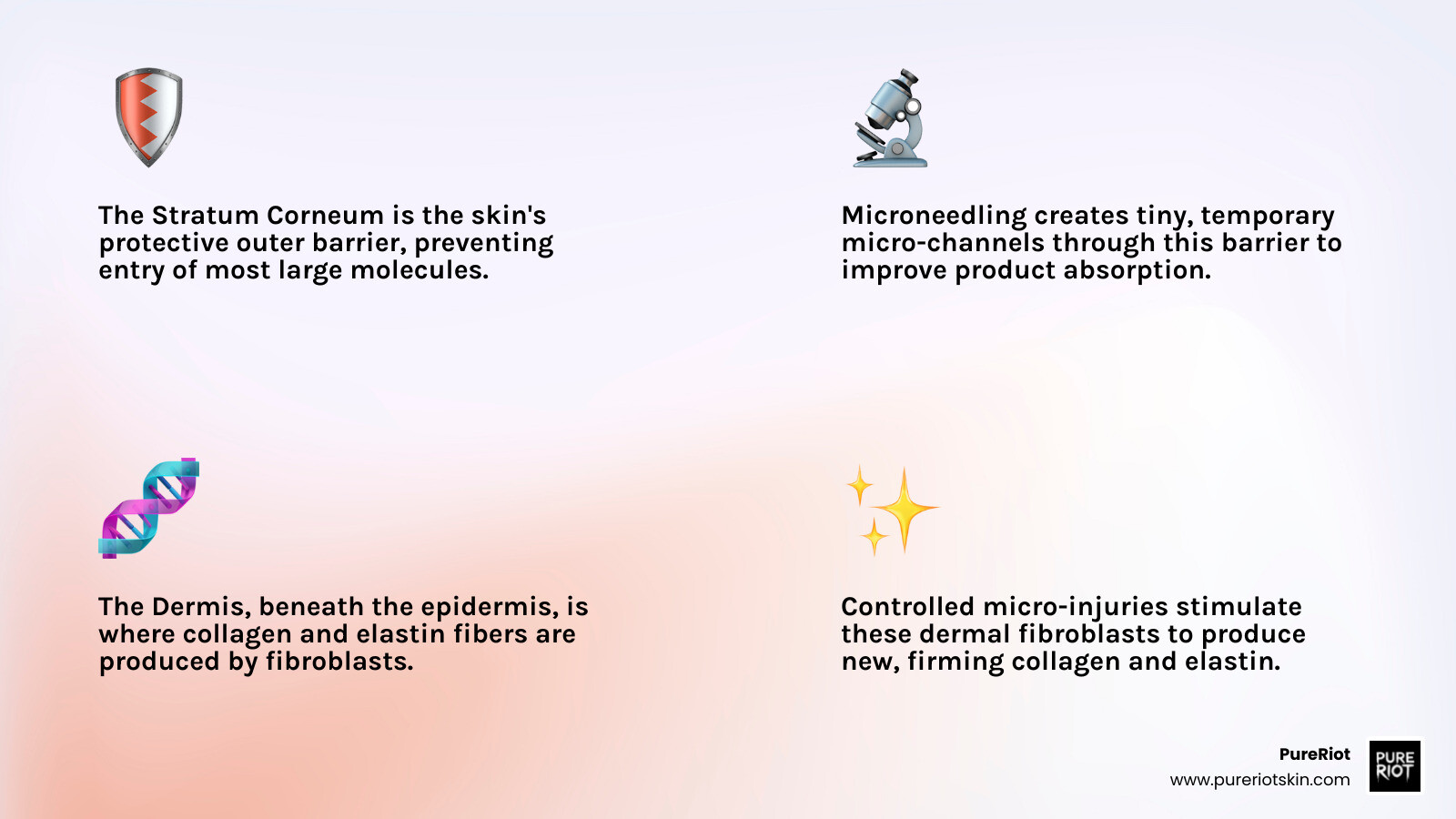
Microneedling works by creating controlled micro-injuries in your skin.
These tiny punctures trigger your body's natural healing response. Your skin rushes to repair itself, producing new collagen and elastin.
More collagen means firmer, smoother, more youthful-looking skin.
The micro-channels created also serve another purpose. They allow your expensive serums to penetrate deeper, bypassing the skin's natural barrier, the stratum corneum, which usually blocks most large molecules. This sounds like a win-win.
But here’s the catch: traditional DIY microneedling at home involves real metal needles. You are deliberately wounding your skin.
This isn't a gentle facial massage. It’s a procedure that carries significant risks when performed outside a professional setting. The FDA warns about microneedling devices, highlighting potential dangers. The FDA states that devices with longer needles or those making medical claims are considered medical devices. And they haven't authorized any for over-the-counter sale.
Your skin is punctured. It’s left with tiny open wounds. This makes it incredibly susceptible to infection and irritation. We’re talking about bacterial contamination, which can lead to serious skin issues.
Then there's the risk of scarring. Push too hard or drag the device and you could cause permanent damage.
Post-inflammatory hyperpigmentation is another concern, especially for deeper skin tones. These dark spots can be harder to get rid of than the original issue.
At-home microneedling devices are difficult to clean. They also dull quickly.
Dull needles don't create clean punctures. They tear the skin.
This isn't just uncomfortable. It increases the risk of injury and infection. The promise of a controlled injury becomes uncontrolled damage.
Using a traditional dermaroller for DIY microneedling at home is a ritual. It demands meticulous preparation and careful execution. This isn’t a casual step in your routine. It is a process filled with risk.
The needle length is the most critical decision you'll make. It dictates both the potential benefits and the risks.
The FDA hasn’t approved dermarollers with needles longer than 0.3 mm for at-home use. They are considered medical devices for professionals only.
Needles at 0.25mm or 0.3mm primarily improve product absorption. They don't penetrate deeply enough to stimulate significant collagen.
Some suggest 0.5mm needles for fine lines or mild scars. But this length increases risk. Pinpricks of blood can appear. This means deeper penetration and a higher chance of infection if your tool is not perfectly sterile.
Longer needles, like 1.0mm or 1.5mm, are for clinical settings only. Using them at home is a gamble where scarring and infection far outweigh any potential benefit.
Sterilization is non-negotiable. Without it, you are inviting infection.
Your tool must be pristine. Soak your dermaroller in 70 percent isopropyl alcohol for at least 10 minutes before you begin.
Your skin must be clean, too. Cleanse your face thoroughly. Then wipe your skin with the same alcohol to create a sterile surface. You are about to create open wounds. You cannot be too careful.

What you avoid is just as important. Stop using retinoids, exfoliating acids, and benzoyl peroxide at least three days before. These make your skin too sensitive.
Stay out of the sun. Do not wax.
And never, ever microneedle over active acne, open sores, or inflamed skin. This spreads bacteria and worsens the problem. Wait until your skin is completely healed.
The rolling itself is a delicate process. Use light pressure. The tool should glide, not drag. If you see blood, you are pressing too hard.
To get even coverage, you roll in a pattern. Roll up and down a section of your face. Lift the roller. Then roll side to side over the same section. Lift again. Then roll diagonally.
You must lift the device completely between each change in direction. If you don't, the needles will drag and tear the skin. This is how you get "tram track" scars.
Avoid the delicate skin around your eyes and on your lips entirely.
After you finish, your skin is vulnerable. It is covered in tiny, open channels. What you apply next matters immensely.
Rinse your face with cool water. Then apply only ultra-gentle, soothing ingredients. Think hyaluronic acid for hydration. Peptides to signal collagen production.
For the next 48 hours, you must avoid anything that could cause irritation. No Vitamin C. No retinoids. No exfoliating acids. No fragrance.
And wear a broad-spectrum SPF. Your skin is now highly susceptible to sun damage.
For more detailed information on what to apply, we’ve explored this topic in depth. What are microneedling serums?.
The traditional skincare industry has trapped us in a cycle. We’re told our skin needs harsh treatments to get results. Or we’re sold products full of synthetic chemicals that promise miracles but often just irritate our skin and slowly break down its natural defenses.
Your skin barrier, the stratum corneum, is incredibly effective at keeping things out. That’s its job. It protects you. But it also means most active ingredients in your expensive serums just sit on the surface. They can't penetrate where they need to go to truly make a difference. This is the hole in your skincare routine.
Traditional microneedling tries to force a solution by creating physical punctures with metal needles. This works, but at what cost? Blood. Numbing cream. Days of redness and swelling. The risk of infection from contaminated devices. The FDA warns about reused cartridges spreading disease. And after all that trauma, the results fade, demanding more sessions.
What if you didn't have to choose between a brutal treatment and ineffective products?
Nature already solved this problem. Millions of years ago.
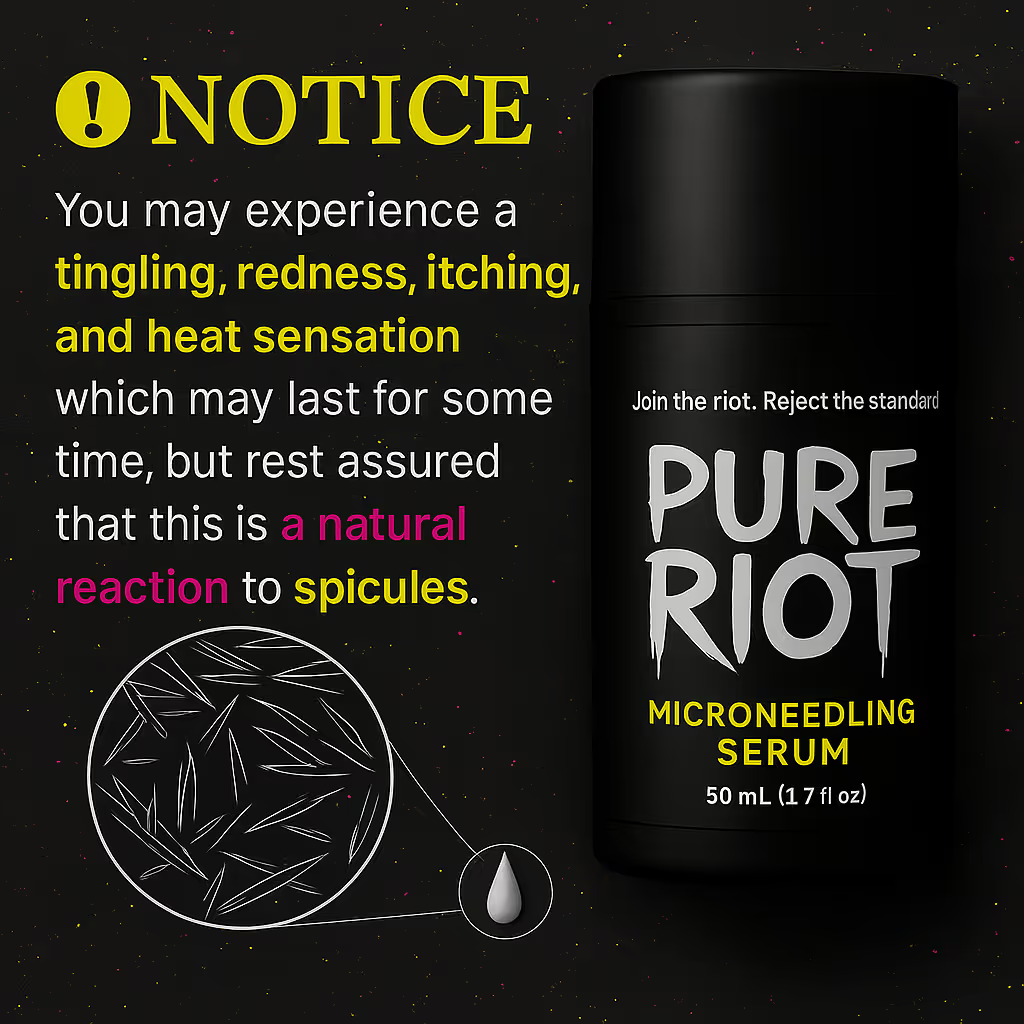
Enter liquid microneedling, powered by Spongilla spicules. These are microscopic, needle-like structures derived from freshwater sponges. They are nature's microneedles.
When you apply a serum infused with Spongilla spicules, you're not using metal. You're using biology. These tiny spicules gently create the same collagen-triggering micro-channels in your skin. Without a single metal needle touching your face.
No blood. No anesthetic. No downtime. No $400 appointments.
The spicules stay in your skin for up to 72 hours, continuing to stimulate collagen production. You'll feel a slight tingle. That's them working. It's feedback, not a problem. This is your skin activating its healing response.
This is what we call true collagen induction therapy, delivered naturally. The micro-channels created by Spongilla spicules are pathways. They allow our science-backed, natural formulations to reach the cells that need them most.
The results happen during recovery. Your skin rebuilding itself stronger than before. This is skin science. Real biology. Actual results.
For a deeper dive into this groundbreaking approach, read about the Science behind microneedling serums: How they work.
We hear your questions. You want clarity. You want to understand. Here are some of the most common concerns about DIY microneedling at home, addressed with truth and science.
The frequency depends on the needle length. This is where people make mistakes.
With a 0.25mm needle, you might use it a few times a week. It's only enhancing product absorption.
For a 0.5mm needle, you must reduce that to once every one to three weeks to allow for healing.
Longer needles, like 1.0mm, require even more recovery time, maybe every four to six weeks. These longer needles are pushing the boundaries of what is safe for DIY microneedling at home.
Your skin needs time to heal and rebuild collagen. Over-microneedling leads to chronic inflammation and a damaged skin barrier.
With liquid microneedling, the rules are different. The stimulation is gentle and continuous. You work with your skin's recovery cycle, not against it.
Not everyone is a candidate for this procedure.
You should absolutely avoid DIY microneedling at home if you have active acne or inflamed breakouts. Puncturing them spreads bacteria and causes more scarring.
You should also avoid it if you have rosacea, eczema, psoriasis, warts, or cold sores. Never microneedle over open wounds or infected skin.
If you have a compromised immune system or a tendency to form keloid scars, the risk is too high. When in doubt, ask a dermatologist. For more insights into safety, you might find this research on microneedling safety profiles helpful.
You need to manage your expectations, especially with DIY microneedling at home using traditional dermarollers.
With at-home dermarolling, you will see improved product absorption. You might notice a slightly smoother texture over time.
But home rollers rarely go deep enough to deliver dramatic results for deep acne scars or wrinkles.
Consistency over four to six months can bring some improvement. Collagen rebuilding is a slow process. It takes three to six months for new collagen to become noticeable.
Liquid microneedling works differently. The stimulation is continuous and gentle. It works with your skin’s biology. Our users report visible improvement in texture, firmness, and tone. It’s not about trauma. It’s about intelligent stimulation that empowers your skin to renew itself.
We believe you shouldn't have to choose between questionable safety and modest results. You deserve a solution that works with your skin, not against it. A solution that delivers professional-grade results without the metal needles, the blood, the pain, and the risks.
We are redefining DIY microneedling at home. We've moved beyond the broken systems of traditional microneedling and the toxic promises of mainstream skincare. We've accepted nature's ingenuity.
This is a smarter approach to skin health. This is working with your skin's biology, using its incredible power of recovery. This is about empowering you to take control of your skin's renewal.
This is PureRiot.
It’s time to experience the difference. It's time for real results, delivered safely and naturally.
Join the riot. Reject the standard.
© 2026 PureRiot. All Rights Reserved.
.png)
